House of F.A. Bragin
The Bragin House was built by Fyodor Afanasyevich Bragin in the early 20th century. and it was intended for rent. The building is a typical type of wooden residential building for the development of Arkhangelsk in the early 20th century, in the appearance of which the architectural forms of the Art Nouveau period were reflected.
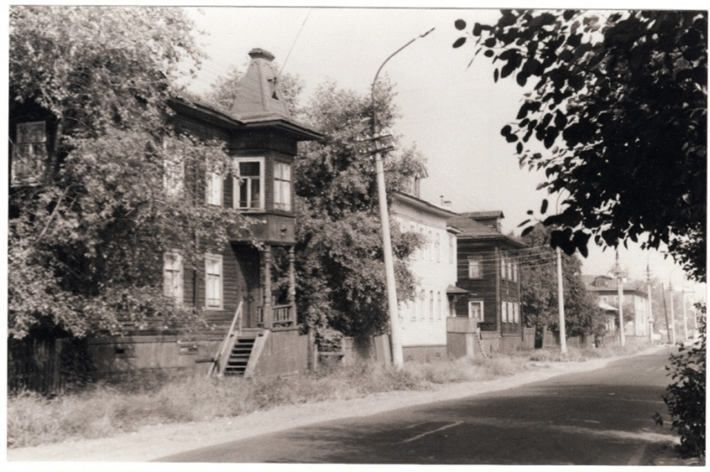
 Monument of history and culture of regional significance
  Arkhangelsk region, Arkhangelsk city, 109 Sovetsky Cosmonauts Ave.
  It was placed under state protection by the decree of the Administration of the Arkhangelsk region "On acceptance for state protection of monuments of history and culture of the Arkhangelsk region" dated 13.08.1998 No. 207.
  The registration number in the unified State Register of Cultural Heritage objects is 321310009530005
The building is located on the red line of the avenue of Soviet Cosmonauts. The main facade faces east. The wooden two-storey house is cut from logs "in a paw" and sheathed with a board. Rectangular in plan, the volume is complicated from behind by a full-height projection with entrances, and also complicated by a vestibule from the north. The main facade is decorated with a bay window with a turret overhanging the main entrance. The bay window is supported by carved columns resting on a high porch.
On the opposite side, the facade is completed with a triangular pediment with a round window in the tympanum. The walls are crowned with a cornice of a large takeaway. The windows are rectangular, in simple frame frames; on the side axes of the main facade – wider, on the second floor of the northern facade – two narrow windows.
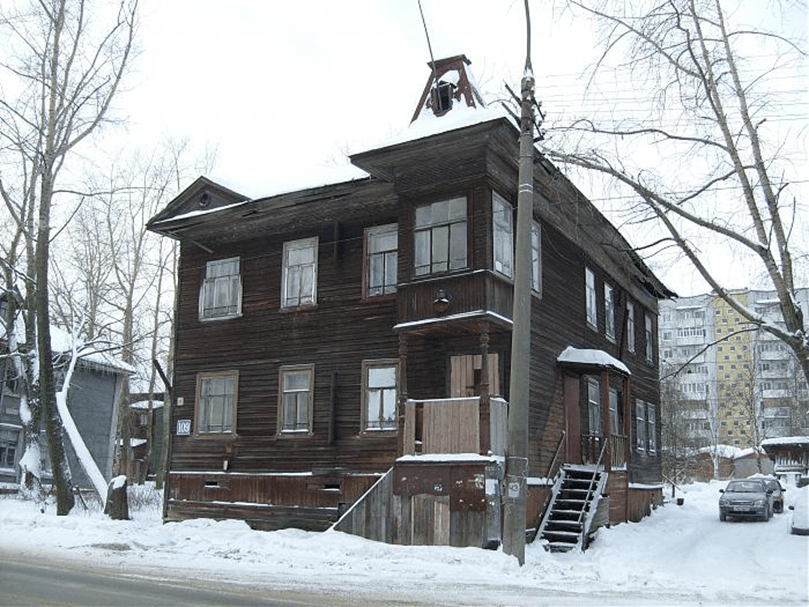
The walls are sheathed with a wide board with profiling, the base and base of the bay window are vertical, the tympanum of the pediment is herringbone.
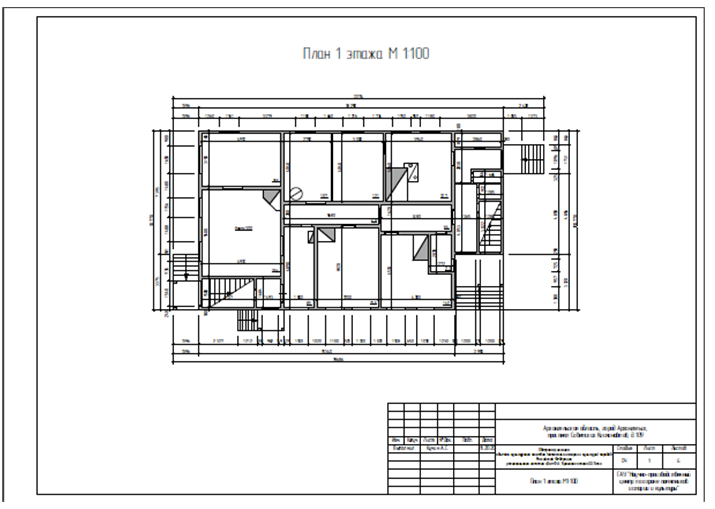
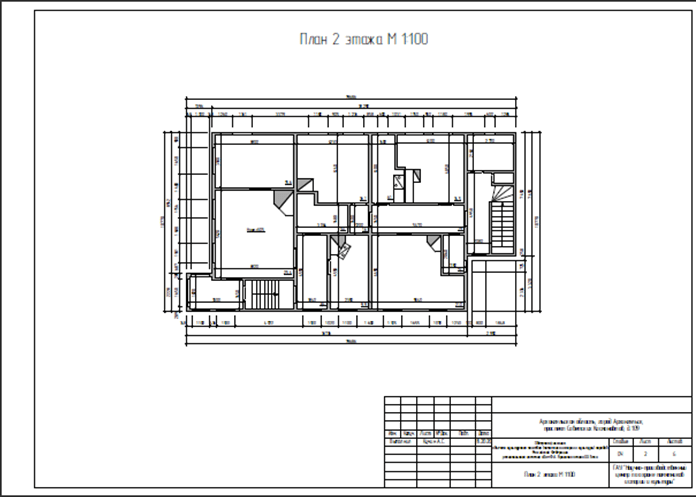
The floors are isolated from each other, each has two entrances. The layout of both apartments, designed for one family, is generally the same (Figures 7, 8). Living rooms are facing the street, utility rooms were adjacent to the rear entrance. On the ground floor, the entrances are connected by an L-shaped corridor, on the second floor part of this corridor is connected to a room. The interiors had Dutch ovens, stretched cornices, stucco rosettes. The architectural characteristics of the building made it possible to put it under state protection in 1998. The subject of monument protection, including composition, architectural and artistic design of facades and spatial planning structure of interiors.
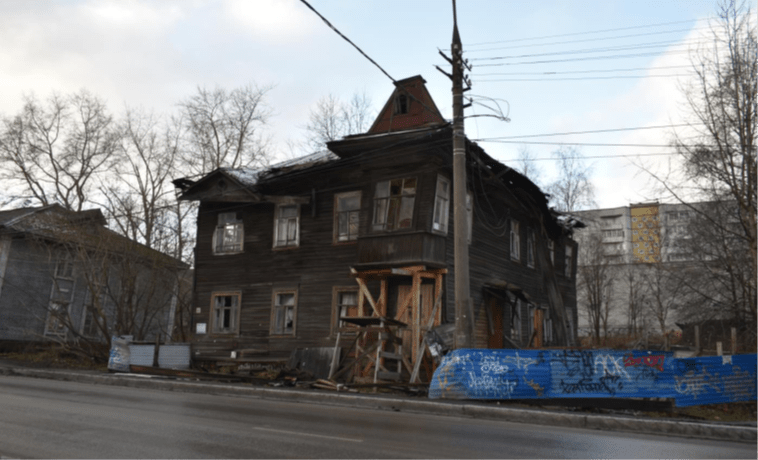 For several years, the monument was in disrepair. As a result of the destruction of the foundation, part of the roof also collapsed, and the pediment overhung the sidewalk.
In 2021, the object was photographed, two facades are shown in Figures 9.10. The condition of the building is emergency.
For several years, the monument was in disrepair. As a result of the destruction of the foundation, part of the roof also collapsed, and the pediment overhung the sidewalk.
In 2021, the object was photographed, two facades are shown in Figures 9.10. The condition of the building is emergency. 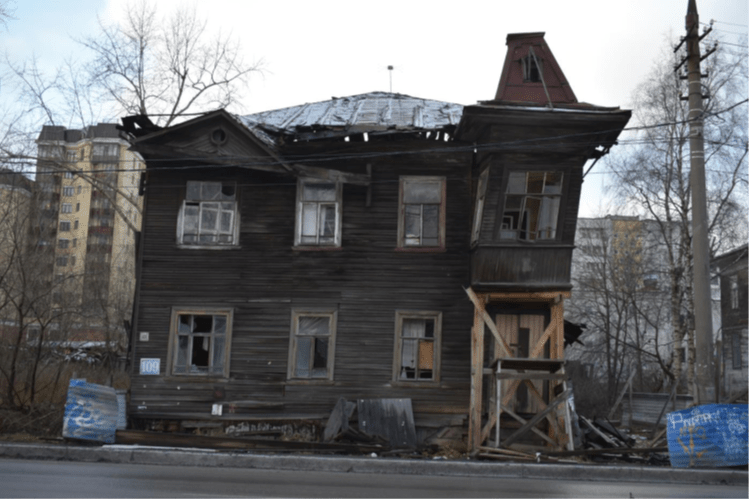 For such facilities, it is necessary to immediately carry out emergency and conservation measures, and for this it is necessary to develop project documentation.